Revista Ítalo-Española de Derecho Procesal
Vol. 1 | 2022 Small claims pp. 51-72
Madrid, 2022
DOI: 10.37417/rivitsproc/680
Marcial Pons Ediciones Jurídicas y Sociales
© Fokke Fernhout
ISSN: 2605-5244
Recibido: 13/09/2021 | Aceptado: 14/11/2021
Editado bajo licencia Creative Commons Attribution 4.0 International License.
The EU Small Claims Procedures in the Netherlands — Some Good and Some Bad News
Fokke Fernhout
Associate professor of law,
Maastricht University, Maastricht (the Netherlands);
attorney at law at the Dutch Supreme Court
ABSTRACT: The EU Small Claims Procedure (henceforth: ESCP) 1 has been implemented in the Netherlands by a separate statute, 2 that entered into force on 10 June 2009. 3 This Dutch Small Claims Act (henceforth: SCA) has been amended in 2017 as a result of the changes in the ESCP of 2017. About the initial implementation of the SCA has been reported in 2013. 4 This contribution will focus on the situation since the amendments of 2017, obviously taking into account earlier developments that still determine the workings of the ESCP.
First, the framework of civil litigation in the Netherlands will be described. Second, the implementation of the ESCP will be discussed and explained. The main part will be devoted to the workings of the ESCP in practice, including an analysis of the way the ESCP is used (and maybe abused). The conclusion will be that in less than 3 % of the cases the ESCP is used in conformity with its objectives, but that legal practice profits from its aspects that help to avoid the workings of other European instruments, especially the EU Service Regulation. 5
KEYWORDS: Small Claims Procedure; Netherlands; Issues in Practice; Statistics: Non-Intended Usage.
SUMMARY: 1. CIVIL PROCEDURE IN THE NETHERLANDS. 1.1. Default procedure. 1.2. Petition procedure 1.3. Enforcement of titles. 1.4. Remedies— 2. IMPLEMENTATION OF THE ESCP. 2.1. Initial implementation of the ESCP. 2.2. Amendments to the SCA in 2017— 3. THE ESCP AS IMPLEMENTED IN THE NETHERLANDS IN PRACTICE. 3.1. Exchange of pleadings and the principle of simplicity. 3.2. Oral hearings. 3.3. Costs (orders). 3.4. Length of the procedure. 3.5. Miscellaneous remarks. 3.6. Use (and abuse?) of the ESCP.— 4. CONCLUSIONS
1. CIVIL PROCEDURE IN THE NETHERLANDS
The ESCP is available to litigants as an alternative to the procedures existing under the laws of the Member States. 6 To understand its implementation it is therefore indispensable to understand the procedural framework within which it functions.
The rules of civil procedure in the Netherlands are mainly to be found in the Wetboek van Burgerlijke Rechtsvordering ([Code of Civil Procedure], henceforth: CCP) and apart from that in some specific statutes. The latter are almost all the result of EU directives which have not been integrated fully in the code just mentioned, mainly because their range of applicability is limited to cross-border litigation. There is no distinction between civil and commercial cases. All civil cases are decided in first instance by District Courts 7, the territorial jurisdiction of which is ultimately determined on the basis of geographical criteria. 8
In general, for civil cases one of two procedures has to be followed. 9 The first one is the procedure introduced with a writ of summons, served by a process server on the defending party. This procedure is the default procedure 10 and will here be referred to as such. The second one is the procedure introduced with a petition, filed at the registry of the competent court. This procedure only applies when this is stipulated by a specific provision. 11 It should be remarked that procedural law does not leave any choice to the parties. The procedural regime is not optional, but mandatory and has to be enforced by the court. When the wrong procedure has been chosen, the court must remit the case to the other procedure. 12 Money claims that are not covered by supranational legislation must follow the default procedure. 13
1.1. Default procedure
Civil proceedings in the default procedure start with a writ of summons, served on the defendant by a process server. The writ contains the statement of claim of the claimant. After service, the writ has to be submitted to the registry by (or on behalf of) the claimant. 14 The case is struck out in an early stage if the claimant does not pay the court fee. 15 If the defendant does not appear, he is sentenced by default on the facts as stated by claimant. 16 If the defendant appears he is only allowed to file a statement of defence after paying the court fee, 17 except when no court fee is due (see infra). When the court fee is not paid in time, the defendant is sentenced by default on the facts as stated by the claimant. The statement of defence may contain any counterclaim, even when completely unrelated to the original claim. 18
Exchange of pleadings takes place in a cause-list sitting. 19 In almost all cases, the statement of defence is followed by a post-defence hearing. An interim judgment sets a date for this post-defence hearing. During this hearing, which on average takes about forty-five minutes, parties are usually given some time to present their opinions, information is gathered and attempts are made to reach a settlement. After the hearing, the court is supposed to give a judgment. Several options are open, such as ordering a witness hearing (enquête or getuigenverhoor) or a site inspection (descente or plaatsopneming), but more often than not a final judgment can be given. Accordingly, at the end of the hearing a date is set for the pronouncement of this judgment.
Within the default procedure, some mostly smaller claims are allocated to a single judge track (kantonrechter [cantonal judge]). These claims are specified in Article 93 CCP as follows:
— money claims up to € 25.000 including interests and costs due before the day the writ of summons has been served;
— claims of which the value is clearly not higher than € 25.000;
— all claims related to rent contracts, (collective) labour contracts, consumer purchase agreements, agency contracts, some retirement agreements and consumer credit agreements, all regardless of the amount claimed.
Procedural rules for the single judge track are the same as the rules for the normal track, except that:
— the writ of summons should contain some extra notifications for the defendant (Article 111 CCP);
— the defendant does not have to pay court fees (Article 4(1)(b) Wet griffierechten burgerlijke zaken [Civil Court Fee Act]);
—legal representation by a lawyer admitted to the bar (advocaat [solicitor/barrister]) is not mandatory (Article 79 CCP);
— the statement of defence and later pleadings do not have to be submitted in writing (Article 82 (2) CCP), while written pleadings will be sent to the parties by the registry (Article 84 (2) CCP);
— minutes of the hearing of witnesses in court are not mandatory in cases in which appeal is excluded (Article 181 CCP);
— costs orders may include travelling costs and lost income of the unrepresented winning party due to its presence at the court hearings (Article 238 CCP);
— appeal is excluded when the claim that had to be decided (together with a possible counterclaim) does not exceed the amount of € 1.750, including interests and costs due on the day the writ of summons has been served (Article 332(1) and (3) CCP);
— cassation in the latter cases is limited to some very specific grounds (Art. 80 Wet op de rechterlijke organisatie ([Act on the Organisation of the Judiciary]), not including the merits of the decision, except when Article 6 of the ECHR has been violated. 20
All other cases are allocated to the regular track. In that case pleadings must always be submitted in writing. Legal representation is mandatory. The cause-list sitting is therefore dealt with electronically. In the regular track, it is up to the court to decide whether the case will be decided by a single judge or by a panel of three judges. Since cases in the regular track tend to be more complicated, time limits for submitting pleadings are longer (six weeks instead of four weeks) and the overall length of the proceedings is also longer.
In the Netherlands, there are no special procedures for debt collection nor for small claims and there is no fast track for cases in which no defence is expected (in fact, there is no fast track at all). These procedures are not missed either, since most debt collection cases fall under the provisions of the single judge track, which produces default judgments within two to six weeks after the date for appearance mentioned in the writ of summons. 21 However, especially in regular track cases, debt collection may profit from the possibility to obtain an interim order from a summary proceedings judge (Art. 254 CCP). These summary proceedings are definitely faster than the regular procedure, since there are no written pleadings, the writ of summons is immediately followed by a court hearing that has been scheduled in advance and judgment follows within two weeks, also when a defence has been filed (against 6-12 months when the regular procedure is followed).
To obtain an interim order for a money claim, on the whole three requirements have to be met: 22
— the claim must be uncontested or only be contested using defences that are clearly ill-founded;
— the claimant must show to be in real need of the money (imminent problems of liquidity);
— the restitution risk (i.e. the risk that the claimant will not be able to pay the money back in case the final judgment proves that he is wrong) must be limited.
In the default procedure, the losing party will have to pay the costs of the winning party. A court may refrain form a costs order (ordering that each party bears its own costs or apportioning those costs between the parties) when the claim is partly denied, and in procedures between family members, (former) spouses, and (former) partners. In case of abuse of procedural possibilities, a costs order may be directed against that party even when that party is the overall winner of the procedure. 23
Costs are limited to court fees, bailiff’s and process server’s fees, remuneration of witnesses and court appointed experts, and lawyer’s fees. 24 As regards the last item, the court has discretion, which allows the court to award the lawyer’s fees fully or only in part. 25 In practice, all courts always apply a fixed tariff when determining the lawyer’s fees. 26 The tariff is based on points based on the procedural activities of a party (statement of defence, being present at a court hearing, witness examination etc.) and a fixed amount per point depending on the value of the case. There is a separate tariff for cases in the single judge track. In regular track cases, the gap between the real lawyer’s costs and the awarded costs is sometimes estimated at 90 %. In cases in the single judge track, the gap turned out to be 75 %. 27
1.2. Petition procedure
The petition procedure was originally meant for non-contentious litigation, especially in family law. This procedure is less adversarial and therefore more suitable when deciding on the measures that have to be taken regarding children, spouses, partners, and similar problems. Over the years, the legislator moved certain forms of contentious litigation in and out of the petition procedure, as has been the case with labour and tenancy cases. The result has been that the court applying the petition procedure and using its large powers of discretion takes into account whether the nature of the case is contentious or not.
In petition cases, for every specific procedure the law determines whether the case is allocated to the single judge track (cantonal judge) or the regular track. In the last case, legal representation is mandatory. 28 Pleadings are always written. In cantonal (single judge track) cases, no court fee has to be paid by the defending party.
The procedure is commenced with a petition filed at the court registry. If the applicant does not pay the court fee, the application is declared inadmissible. 29 The court should order an oral hearing, unless the petition can be granted without a hearing. 30 It is the court’s responsibility to summon all interested parties to the hearing, the costs of which by lack of a provision stating otherwise are all paid by the State. 31 Every interested party has the right to file a written defence, 32 for which in the regular track a court fee has to be paid. If the court fee is not paid, the written defence is not taken into consideration. 33 In single judge track cases (cases before the cantonal judge), no court fee is due. 34 An oral defence is always possible and free. 35 A written defence may contain a counterclaim, but this counterclaim should be related to the original petition. 36
After the hearing the court decides about the continuation of the procedure. Evidence can be taken, which in family cases mostly consists of reports from experts or advices from institutions like child welfare offices. In contentious cases, the normal rules of (the taking of) evidence apply. 37 In the order deciding on the petition, the court may decide about the costs without having any obligation in that respect. 38 A costs order can be given against either party with the only restraint that it should not be unreasonable. 39
1.3. Enforcement of titles
All judgments and court decisions (like all other writs of execution) containing orders against one of the parties are enforceable by all means provided by the law as of right. No leave or court permission is needed; the choice of the method of enforcement is entirely left to the creditor. However, enforcement measures can only be taken by bailiffs, who will have to check whether the means of enforcement chosen are in accordance with the law and reasonable in the given circumstances. The measures to be taken include attachment, seizure, garnishment, and sometimes even civil arrest.
Enforcement is suspended in case the debtor filed an ordinary remedy (opposition, appeal, cassation) against the judgment. This can be prevented when the judgment has been declared immediately enforceable by the court. The order of immediate enforceability is left to the discretion of the courts in both procedures, 40 but in practice an application for such an order (usually combined with the claim itself in the writ of summons or the request in the petition) is always granted, even when contested. Enforcement of an immediately enforceable judgment is at the risk of the creditor. If the judgment is quashed later, the creditor will be liable according to tort law for all the damages caused by the enforcement, since the quashed judgment is deemed not to have existed at all. 41
1.4. Remedies
In the default procedure, the defendant convicted by default has the remedy of opposition. Opposition starts with a writ of summons, served by a process server on the plaintiff on the request of the defendant, and reopens the original procedure before the court that gave the judgment. The writ of summons should contain the statement of defence. 42 In the petition procedure, the remedy of opposition is not available.
All appeals are decided by the appellate courts (Gerechtshoven). The procedure that is followed in appeal depends on the procedure of first instance (default or petition). In general, the party appellant submits his complaints in written form, to which the other party responds. Ordering a hearing is left to the discretion of the court in the default procedure and is mandatory in the petition procedure. In both cases, the appeal procedure is governed by the principle of devolution (tantum devolutum quantum appellantum). This means that the appeal is to be seen as a continuation of the law suit started in first instance. The appellate court cannot remit a case, but has to decide on it, taking into account all grounds and defences that have been put forward in both instances.
In petition cases, every decision is open to appeal for all the parties involved, unless the possibility of appeal is explicitly excluded in a special provision. 43 In the default procedure, when not explicitly excluded appeal is open in all cases in which the court had to decide on an amount of more than € 1.750, including interests and costs due on the day the writ of summons has been served. The amount on which the court had to decide is calculated by adding all claims and counterclaims. 44
Cassation at the Supreme Court is open in all cases that cannot be appealed, including the decisions of the appellate courts. 45 In small claims cases up to € 1.750 the grounds of cassation are limited to some formal aspects of the decision and violation of art. 6 ECHR (see supra). Apart from that, cassation is not about the facts but about the law only. Complaints about factual issues cannot be submitted to the Supreme Court.
2. IMPLEMENTATION OF THE ESCP
The ESCP leaves the implementation of the ESCP to the Member States in so far as the regulation itself leaves matters unregulated. 46 This section describes first the initial implementation and will then consider the changes that were made pursuant to the amendment of the ESCP in 2017.
2.1. Initial implementation of the ESCP
The EU Small Claims Procedure was implemented in the Netherlands in 2009 by a separate statute, which is referred to here as SCA (see supra). The SCA has no other purpose than to fill in the gaps of the ESCP. Therefore, the scope of the SCA is identical to the scope of the ESCP. 47
The provisions of the SCA —though not explicit in this respect— have to be understood such that the District Court is the competent court for claims falling under its scope. These claims are allocated to the single judge track (see supra). 48 The Civil Court Fee Act applies, 49 which means that the claimant has to pay a court fee based on the value of the claim and the defendant is exempted from paying court fees, since the procedure has been allocated to the single judge track. 50 A claimant who does not pay the court fee will be declared inadmissible (Article 282a CCP). There are no provisions concerning the language to be used, which means that the application has to be written in Dutch or Frisian. 51 The rules of the petition procedure apply, unless the SCA or ESCP provide otherwise. 52
This implies that territorial jurisdiction in absence of a provision of international law stating otherwise 53 is determined by Article 262-269 CCP. According to Art. 262 CCP, territorial jurisdiction is assigned to the court of the place of residence of the applicant, unless one of the special provisions of Art. 262-269 applies (which will be exceptional in ESCP cases). If the applicant does not have his place of residence in the Netherlands, the case belongs to the territorial jurisdiction of the District Court of The Hague. 54 The courts are bound to remit the case of their own motion if it does not belong to the jurisdiction of the court. 55
The applicability of the rules of the petition procedure also implies that in principle the court has a large discretion regarding costs orders (see supra). However, this discretion is limited by Article 16 ESCP, prescribing that the losing party shall bear the costs of the proceedings, unless these costs were unnecessarily incurred or disproportionate to the claim. In Dutch Parliament it was assumed that this rule has to be explained in the light of Dutch law. 56 Apart from the above, Article 5 SCA stipulates that the Articles 238, 241, 242 and 244 CCP shall apply correspondingly. This means that travelling expenses of the winning party can be included in a costs order if this party was not represented by a lawyer or other proxy, that non-legal expenses covered by a costs order cannot be awarded separately and that agreements regarding costs may be moderated by the court.
Appeal from the judgment in a SCA small claims case, is excluded. 57 This has been firmly criticized in Dutch literature, 58 which led to one of the amendments made to the SCA in 2017. Cassation is possible, but only on limited, formal grounds. 59 Cassation can only be lodged with the Supreme Court. Since the rules of the petition procedure apply, the time limit for this appeal in cassation will be three months, starting the day the judgment was pronounced in public. 60 Opposition against a decision by default will be impossible, since the rules of the petition procedure apply (see supra section 2.4).
The review procedure of Article 18 ESCP is regulated by Article 6 SCA. The general rules for the petition procedure apply, so legal representation is not mandatory, since the case has been allocated to the single judge track. 61 The time limit for review is set at four weeks
— from the day the defendant got to get knowledge of the judgment in the case of Article 18 (1) (a) Regulation 861/2007;
— from the day the defendant was no longer prevented from objecting to the claim in the case of Article 18 (1) (b) Regulation 861/2007.
2.2. Amendments to the SCA in 2017
Amendments to the ESCP in 2017 necessarily led to a reconsideration of the implementation of the ESCP. The resulting changes were enacted in the Act of 22 March 2017, 62 which entered into force on 14 July 2017. 63
Obviously, the scope of the SCA was adapted in accordance with the change of the maximum amount of the claim to € 5.000 in the ESCP. This change threatened to create a disparity between ordinary cases in the default procedure, which could be appealed when the value of the claim was over € 1.750, and the ESCP cases, which until then could not be appealed at all. The legislator decided therefore to create a possibility of appeal for ESCP cases on the same conditions and under the same rules as default procedure cases, with the only difference that the period for appeal was limited to 30 days instead of 3 months. 64 The new possibility of appeal only applies to cases that were filed after 14 July 2017, the day the amended implementation entered into force. 65
It has to be noted that these choices promised to create a lot of confusion. The implemented ESCP follows the rules of the regulation, which are supplemented by the SCA, which in turn is supplemented by the rules governing the Dutch petition procedure. Yet in case of appeal, the rules of the default procedure apply, but the period of appeal is shortened to 30 days. It is easy to see that all this will not contribute to the principles of simplicity, speed and proportionality which should cover this procedure. 66
The change of art. 18 ESCP, introducing a time limit for review of 30 days, made the Dutch specification of these limits unnecessary. Therefore Article 6(2) SCA was repealed.
3. THE ESCP AS IMPLEMENTED IN THE NETHERLANDS IN PRACTICE
As regards the working of the ESCP in practice, attention will be paid to the exchange of pleadings, the use of oral hearings, the costs orders, the length of the procedure and some miscellaneous subjects. This will be followed by an analysis of the characteristics of the cases in which the claimant chose to make use of the ESCP.
What is stated in this section is exclusively based on published judgments. In the Netherlands, judgments are published by the Council of the Judiciary on the website www.rechtspraak.nl. This website is an extremely useful and highly appreciated source to study case law. New cases are added on a daily basis to a total approaching 20.000 civil cases per year. The total number of cases (including criminal and administrative law) at this very moment is 354.157 and the aim is to ultimately publish 1/3 of all judgments and court decisions.
The criteria for publication are laid down in the Besluit selectiecriteria uitsprakendatabank Rechtspraak.nl [Decree regarding publication criteria for the case law database Rechtspraak.nl]. The judgments of the four High Courts are all published and when it comes to the lower courts, it depends on their contents and relative importance. As long as these criteria do not create a bias towards a certain topic of research, any findings from this database will also have an empirical value. If for instance the gender of suspects is expressed in a judgment, just counting the number of female suspects in the database will give an extremely good estimate of the percentage of female suspects in Dutch courts, since the publication criteria are neutral towards the gender of suspects and therefore in this respect the database gives us a random sample.
Using this feature, something can be said about the whole population of ESCP cases by studying the cases in the database of <www.rechtspraak.nl>. At this moment, the database contains 228 ESCP judgments related to 220 unique court cases. 67 Since the population of ESCP cases is in principle homogenous (there are no regional differences to take into account, for instance), this is a sufficient sample to draw some conclusions about the way things work, even though the size of the entire population is not known (see infra). The number of published judgments varies enormously over the years, 68 but that will only reflect the variations in yearly influx.
The total number of ESCP cases in the Dutch courts is unknown, simply since no-one counts them in a systematic way. We do know, however, that there has been an enormous increase since 2017 (the year in which the scope of the ESCP was broadened to claims with a value up to € 5.000). In 2016 the total number of ESCP cases for all of the Netherlands was estimated at a mere 20 to 30. 69 If we take the number of published cases in 2020 (47.236) in relation to the total number of cases in Dutch courts (1,37 million) and we apply the same proportion to the number of published ESCP cases in 2020 (64), then we obtain a total of 1855 cases for 2020. This should be a reliable estimate, since it is not much different from informal information obtained from court employees. Below it is argued that this increased popularity cannot be attributed to the intrinsic qualities of the ESCP itself.
The figures mentioned are more or less corroborated by an informal counting done by the administration of the District Court Rotterdam. 70 It appears that the computer system of the Dutch courts provides a field tagged ‘Remark’ and a field tagged ‘Subject’. Some courts use these fields to indicate that a procedure falls under the scope of the ESCP, although we do not know how consistently this is done. These fields have been searched using keywords like “small claim” and “geringe vorderingen”. This led to the following overview, which is the best that can be produced at the moment.
|
NUMBER OF ESCP PROCEDURES |
YEAR FILED |
TOTAL |
|||
|
Court |
2018 |
2019 |
2020 |
2021 |
|
|
Rechtbank Amsterdam |
26 |
42 |
176 |
41 |
285 |
|
Rechtbank Den Haag |
8 |
17 |
16 |
10 |
51 |
|
Rechtbank Gelderland |
10 |
23 |
15 |
15 |
63 |
|
Rechtbank Limburg |
15 |
6 |
16 |
2 |
39 |
|
Rechtbank Midden-Nederland |
13 |
7 |
8 |
4 |
32 |
|
Rechtbank Noord-Holland |
2 |
1 |
7 |
10 |
|
|
Rechtbank Noord-Nederland |
4 |
4 |
12 |
1 |
21 |
|
Rechtbank Oost-Brabant |
449 |
1067 |
579 |
104 |
2199 |
|
Rechtbank Overijssel |
5 |
4 |
4 |
2 |
15 |
|
Rechtbank Rotterdam |
1 |
2 |
3 |
1 |
7 |
|
Rechtbank Zeeland-West-Brabant |
5 |
1 |
3 |
9 |
|
|
TOTAL |
538 |
1174 |
839 |
180 |
2731 |
Figure 1. Table of ESCP cases registered in the court systems per court and per year.
Below it will be shown that 89 % of the ESCP cases is based on the Flight Compensation Regulation (see below). Many of these cases are related to the airports of Schiphol (District Court Noord-Holland) and Eindhoven (District Court Oost-Brabant). The latter court is apparently very precise in registering ESCP cases, since we can follow the increase in ESCP cases from 2018 to 2019 and the decrease from 2019 to 2020, reflecting the decrease in air travel due to the CODID-19 pandemic.
In general, these statistics confirm that the ESCP has rapidly become more popular, increasing from 30 cases a year in 2016 to at least 1174 in 2019. In fact, the procedure has been discovered by claimants, but it will be shown below that this is not due to its procedural merits. The rest of this section is devoted to the procedural complications the ESCP evokes and the way the procedure is used in practice.
3.1. Exchange of pleadings and the principle of simplicity
The ESCP has been designed as a written procedure in which the decision if possible should be given after one written round of pleadings. 71 Therefore, oral hearings are considered as something exceptional, 72 whereas at the same time Article 7 (1) of the regulation seems to imply that a second written round should not occur too often.
In practice, it simply does not work that way. It is impossible for the claimant to foresee all defences of the defendant, so it is to be expected that sometimes a reply is needed for the sake of justice and the right to a fair trial. Moreover, some defences are such that the claimant will have to take additional steps to secure the admissibility of the claim. This is unavoidable when, like in the case of the ESCP, legal representation is not mandatory. Parents without legal schooling will not know, for instance, that to represent their children in court an authorization of the cantonal judge may be needed. 73 Apart from that, cross-border litigation always adds legal dimensions to a case that are and cannot be simple, like the international jurisdiction of the court and the applicable law.
As was to be expected, in a large number of the published cases (93) the court gives permission for or asks for additional pleadings. This amounts to 42,3 % of the total number of cases. When the court sticks to the original idea of one written round for the sake of ”simplicity” for better or for worse, the outcome becomes blatantly unjust when the other party does not get the opportunity to reply to new statements or documents. 74 The percentage therefore should even have been higher.
The pressure provided by this “principle of simplicity” even serves as an excuse for courts to avoid complications. In a case before the District Court of Noord-Holland, the court concluded that, since the Italian defendant had gone bankrupt, the receiver of the bankrupt company should be summoned to the proceedings. The court decided however that this was too complicated —despite its obligations under Article 5(2) and 13 of the Regulation— and declared the claim inadmissible. 75
In another case (the AirBNB-case) the claimant stated that under Dutch law AirBNB was not allowed to charge the renter for its services. This was supported by grounds taking six pages in addition to Form A. Form C of the defendant was supplemented with 57 pages of defences. The claimant also stated that the decision could have a large impact on all contracts of AirBNB in the Netherlands. The cantonal judge then decided that the ESCP does not leave any room for debates like this and refused to give a decision. The claim was dismissed. Moreover, contrary to Dutch law, the court qualified the claim as one of indeterminate value, giving a costs order against the claimant that was much higher than justified by the value of the claim. 76 Thus the disparity between the “ideal” procedure as wished by the ESPC and legal reality gives courts a pretext to avoid difficult decisions. It will not come as a surprise that this AirBNB decision was heavily criticized in Dutch literature. 77 Fortunately, other courts asked to rule on these issues concerning AirBNB took a different stance. 78
3.2. Oral hearings
The idea behind the ESCP is that oral hearings should be avoided. This appears from Article 5(1a) ESCP, stating that oral hearings should only be held when necessary and that a request for an oral hearing (which is one of the cases to be ticked on Form A) can be denied when an oral hearing is not necessary for the conduct of the proceedings.
As far as appears from the published judgments, a request of the claimant in Form A for an oral hearing is always denied (8 cases). In 9 cases out of 220 (5 %), a hearing was ordered, apparently by the court of its own motion under Article 7 (1)(c) or at the request of the defendant. As far as could be established, none of these hearings used any form of distance communication technology. 79 This can be explained from the fact that in 8 out of 9 of these cases the claimant was Dutch (see infra for this peculiar state of affairs) and the defendant a foreign company with representatives in the Netherlands. In the 9th case, the claimant was from Luxembourg, did not show up at the hearing but submitted comments to what was said in written form. 80
This limited use of oral hearings is in conformity with Dutch litigation in other small claims cases. 81 The courts are stimulated by the CCP to order an oral hearing, 82 but especially in the single judge track these hearings are avoided since they are often disproportionate in relation to the value of the claim. The use of oral hearings in ESCP cases therefore does not deviate from practice in other small claims cases.
3.3. Costs (orders)
Article 16 ESCP stipulates that “the unsuccessful party shall bear the costs of the proceedings”. It has already been remarked that according to the Dutch legislator this should be interpreted in the Dutch way. This means that the legislator recommended to follow the regular practice of awarding costs using a fixed tariff that is unrelated to the real costs of a party.
The courts follow this recommendation without any exception. The tariff applied is to be found on the site of the Dutch judiciary. 83 To give an idea, for a claim between € 1.250-2.500 to cover the costs of legal assistance an amount of € 187 is awarded for every action that corresponds with a point. Filing Form A or Form C yields 1 point, reacting to a later pleading of the other party yields 1 point and attending an oral hearing yields 1 point as well.
The costs order also covers the court fee that has been paid by the claimant. 84 There is a nicety in Dutch law that helps the claimants to reduce these costs to a more convenient amount. In cases following the default procedure, every claimant will have to pay a separate court fee for his part of the claim. On the other hand, in the petition procedure, the court fee is calculated only once, independent of the number of applicants and claims. 85 Since the provisions of the petition procedure apply (Article 9 SCA), claimants may profit from this peculiarity by combining their claims in one form. In practice, this is what actually happens. Taking the published judgments given in the months of March and April 2021 as a sample, this yields an average number of 2,6 claimants per Form A.
In determining whether a party is unsuccessful, the courts mostly follow the rule that rejecting only a (relatively) small part of the claim (or awarding only a small part of the claim when we look at the defendant) does not make a party unsuccessful. In those cases, the costs order is fully awarded in favour of the claimant viz. defendant. 86 However, judgments in which part of the claim is rejected are not consistent, varying from full compensation even though half of the claim was rejected 87 to no costs at all in a case where only € 60 of a total claim of € 685,54 was not awarded. 88
Usually, rejection of around 50 % of the claim leads to the decision that each party has to bear its own costs. 89 This is standard practice under Dutch law and not incompatible with Article 16 ESCP. 90 However, when we look at cases in which combined claims of different claimants had to be decided, the pattern becomes chaotic when some of these claims are rejected and others awarded. In some decisions of this kind, each party has to bear its own costs, 91 whereas in others the costs order is fully in favour of (all of) the claimants. 92 Logic nor Article 16 ESCP supports either of these approaches, since in both cases there is at least one successful party that does not get the costs order it is entitled to. The decision in which no costs order was issued on the ground that the claimant did not have a claim, but could be excused for having thought so, seems equally incorrect. 93
3.4. Length of the procedure
The ESCP intends to speed up small claims litigation in cross-border cases. 94 To determine the speed with which these cases are dealt with a sample of first instance decisions was taken from the database of all 228 published judgments, ordered by date, by taking every fifth judgment (1, 6, 11 and so on). If a judgment did not contain the necessary information or the case was undisputed, 95 the next judgment was taken. This resulted in 46 scores with an average of 330 days, with the first judgment from February 2010 and the last from April 2021. Figure 2 shows the development in time with the caveat that considerably more judgments were published in the last three years (see supra).
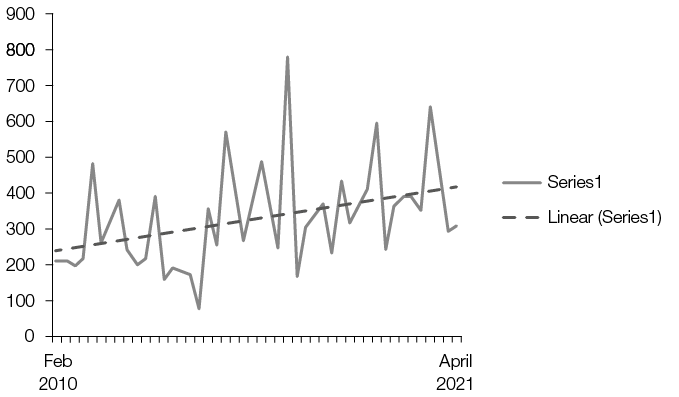
Figure 2. Throughput time of contested cases from 2010-2021.
There is a definite increase in the throughput period of a judgment over time. The explanation will be that these procedures are no longer prioritized (they are not new anymore) and that the defences became stronger (which is related to the lopsided distribution of these cases over private law, as will be discussed below). The explanation cannot be that in general throughput times have increased, since these have been rather constant since 2010 (see the source mentioned below).
The average of 330 days (11 months) as such —which average is even higher when only the last three years are taken into consideration— is very poor, bearing in mind that this is a written procedure (only 9 % oral hearings) and that evidence is literally never taken (see infra). In ordinary cases 93 % is dealt with within a year, including the taking of evidence. 96 The cause should be found in the design of the ESCP, which is, notwithstanding all the proclamations in the recitals of the regulation, not really suitable to speed up proceedings. The basic idea of the ESCP seems to bring the court to the parties instead of the parties to the court. In the latter case, parties who appeared are deemed to inform themselves about the next step instead of being informed. Probably, that would make a difference.
3.5. Miscellaneous remarks
There are several smaller topics that still deserve some attention. They will be enumerated in this single section for the sake of briefness. They are:
— In 119 out of 153 cases in which (part of) the claim was awarded, a certificate as mentioned in Article 20(2) ESCP was asked and issued. Why the claimant did not ask for a certificate in the remaining cases, is a mystery. Probably the question in the form is not fully understood by all claimants. It would be better and fairer to have a certificate issued in all cases. Moreover, in only 12 cases the certificate was (visibly) issued in the language of the State of the defendant. All other certificates were therefore probably useless. It would be better to have the certificate issued in the language of the State of the defendant, unless the claimant requests otherwise.
— No certificates were issued on behalf of the defendant in cases where the defendant obtained a costs order against the claimant. This shows that the forms are unfair. The claimant is asked expressly whether he wishes a certificate or not, whereas the form to be used by the defendant (Form C) does not mention the subject at all. This problem could be solved when certificates are issued in all cases by the court of its own motion.
— Courts seem to overlook the subtleties that are hidden in the multi-layer structure of rules applicable to ESCP cases. Mistakes are made that show that courts have a problem to get used to the mix of procedural rules that is concocted by the Dutch legislator (see supra). An example not yet mentioned is declaring a decision immediately enforceable. In Dutch law this is necessary, since remedies suspend the enforceability of a decision. Article 15(1) ESCP rules this out for decisions given under the regulation, so a declaration of immediate enforceability does not make sense. Nevertheless, 17 judgments (almost 10 %) were counted that were declared immediately enforceable.
— Evidence other than in the form of documents is never taken in ESCP cases, although Article 9 (2) ESCP expressly allows for this. This confirms the uneasy feeling that the courts feel a pressure to take a decision on the file as it is with disregard of the rights of the parties under Article 6 ECHR.
— There was only one decision in which a counterclaim was filed. Since the court assessed the counterclaim at an amount of more than € 5.000, the case was remitted to the default procedure (Article 5(7) ESCP). Nevertheless, several mistakes were made in this decision. The court overlooked that counterclaims should arise from the same facts or the same contract to start with. 97 Moreover, once a counterclaim fulfils this requirement international jurisdiction, contrary to what the court assumed, has to be taken for granted. Once again, the regime of the ESCP is far more complex than the regulation seems to believe.
— Language issues did not really occur. The courts are willing to take into account pleadings written in English, even though this is not the official Dutch language. 98 Since in 89 % of the published cases the defendant is an airline company, this is understandable. When an airline company insists on pleadings in another language, the court is willing to ignore this. 99
3.6. Use (and abuse?) of the ESCP
Obviously, the ESCP is meant for litigation in which the claimant has a claim on a defendant in another Member State and has to litigate in that State. After all, realizing a claim in one’s own country does not encounter any obstacle that distinguishes a small claim under € 5.000 from any other national claim. In cases where the defendant is a resident of another Member State, the EU Service Regulation gives the rules regarding service and transmission of documents, so that is already provided for.
This rationale of the ESCP is confirmed by Recital 7 to the regulation, which states that the objective of the procedure is to facilitate access to justice. In national litigation, there are no specific obstacles to access to justice. Moreover, the examples given in the Commission proposal 100 all show that the ESCP primarily aims at the situation in which the claimant had to start proceedings in another Member State than his own.
In the proposal it is remarked that in a cross-border context “it will often be necessary to hire two lawyers, there are additional translation and interpretation costs and miscellaneous other factors such as extra travel costs of litigants, witnesses, lawyers etc.”, 101 all of which does not occur in litigating a claim before one’s own national courts. On the same page the Proposal mentions that owners of small businesses want to pursue their claims in another Member State and it speaks of the practical difficulties which are likely to ensue, which obviously do not arise in litigation before one’s own courts.
The fact that, contrary to the original proposal, the Council and Parliament decided to limit the scope of the ESCP cross-border cases, confirms this point of view.
In the Netherlands, the actual use of the ESCP is not at all in conformity with these original ideas. Out of 220 cases, only 6 cases were initiated by a claimant outside the Netherlands against a defendant in the Netherlands (less than 3 %). Almost all of the remaining cases had a claimant inside and a defendant outside of the Netherlands, although in 8 cases it could be established that both parties were not Dutch residents. 102 Overall, 89 % of all cases concerned claims based on Regulation 261/2004 (Flight Compensation Regulation). For these claims, the Rehder judgment 103 attributes international jurisdiction to the court of the place of departure and the court of the place of arrival of the aircraft, which explains why the Dutch courts are allowed to decide many of these cases even though the defendant has his residence in another country.
The question is why specifically in cases where the claimant is a Dutch resident and the defendant a resident of another Member State, the ESCP is chosen. There is little evidence that this is done because of the swiftness of the ESCP, since the procedure has proven to be slower than the Dutch default procedure (see supra). The fairness of the procedure will not be an argument either, since evidence will not be taken and there is a risk of losing the case because the court decides on the defences of the defendant only without allowing any reply (see supra). The fact that the procedure may be commenced with a form could be attractive, but since most claimants are represented by professionals and semi-professionals (like specialized debt-recovery agencies) this seems not very likely either.
The best explanation seems to be that by following the ESCP the costs, delays and complications of the EU Service Regulation can be avoided. Using the ESCP, it is up to the courts to serve the form on the defendant; the claiming party does not have to bother and does not have to pay. That is a huge relief, since following the EU Service Regulation amounts to paying twice (in both States the process server had to be paid), to waiting a long time and to uncertainty about the outcome of service abroad. This analysis is confirmed by the fact that claims are sometimes actually transferred to a party outside the Netherlands with the sole objective to make it possible to use the ESCP. 104
4. CONCLUSIONS
Although no official statistics are available, it seems that the procedure has become very popular in the past few years. Probably around 5000 ESCP cases are now commenced on a yearly basis. In 2016 this was estimated at a mere 20 to 30. That is the good news. However, from an analysis of available case law (228 judgments) some conclusions about the ESCP have to be drawn that mostly show that the popularity of the procedure is probably not related to its intrinsic qualities. That is the bad news. These conclusions are the following.
First of all, the idea that one written round is the rule and a more complicated form of litigation the exception, does not fit the facts. Cross-border cases are intrinsically complicated and at least in half of the disputed cases more procedural steps were necessary than one written round. Moreover, the idea of one written round seems to put some pressure on the courts, which could lead to an unjust outcome.
Second, evidence is never taken. There is no chance that this is accidental and it seems to violate the right to a fair trial in some cases.
Third, close analysis of the decisions shows many smaller and bigger mistakes made by the courts. This could be due to the fact that there is a four-layered legal framework within which litigation has to be conducted: the ESCP regulation, supplemented by the implementation act, supplemented by the rules for the Dutch petition procedure and in appeal replaced by the rules for the Dutch default procedure. The “principle of simplicity” should have been taken as a guideline to avoid this state of affairs.
Fourth, ESCP cases are slower than ordinary cases, not faster. This could be due to the fact that every step involves separate communications between the parties and the court.
Fifth, when it comes to costs orders, the rules set down by the regulation and the ECJ are respected. However, the amounts awarded for legal representation are based on Dutch tariffs that cover approximately only 25 % of the real costs.
Sixth, 89 % of all ESCP cases are based on the Flight Compensation Regulation. Of all cases, less than 3 % is a cross-border case with a claimant outside of and a defendant inside the Netherlands. The ESCP is therefore used for other purposes than it was meant for. This can probably be explained by the wish to avoid the costs and delays caused by the EU Service Regulation. The unpleasant conclusion that the EU Service Regulation is a major obstacle to an effective enforcement of cross-border consumer rights seems to be inevitable.
1 Established by Regulation (EC) No 861/2007 of the European Parliament and of the Council of 11 July 2007, as amended by the Council Regulation (EU) No 517/2013 of 13 May 2013, Regulation (EU) 2015/2421 of the European Parliament and of the Council of 16 December 2015 and the Commission Delegated Regulation (EU) 2017/1259 of 19 June 2017. The abbreviation is also used for the regulation itself.
2 Uitvoeringswet verordening Europese procedure voor geringe vorderingen ([Implementation Act of the European Small Claims Procedure Regulation]). It has been modified in 2010 to comply with the new Dutch Civil Court Fee Act (Staatsblad [Dutch Bulletin of Acts Orders and Decrees] 2010, 715.
3 Dutch Bulletin of Acts Orders and Decrees 2009, 234.
4 F.J. Fernhout, Simplification of debt collection in the EU: the Netherlands, National report, EU-project JLS/2009/JCIV/AG/003-30-CE, <http://www.acj.si/en/pres-simpf>, 2013, p. 1-12. The book version of this report is to be found in F.J. Fernhout, Netherlands: Debt Collection in the Netherlands from a National and EU Perspective, In: V. Rijavec, Tjaša Ivanc, Tomaž Keresteš (eds.), Simplification of Debt Collection in the EU, Alphen aan de Rijn: Kluwer Law International 2014, p. 327-346. On a national level the workings of the SCA was discussed in X.E. Kramer, E.A. Ontanu, ‘The functioning of the European Small Claims Procedure in the Netherlands: normative and empirical reflections’, NIPR 2013, nr. 3, p 319-328, and X.E Kramer, ‘Ervaringen met Europese civiele procedures in Nederland’ [Experiences with European civil litigation in the Netherlands], NtEr, 2014, nr. 4, p 99-108.
5 Regulation (EC) No 1393/2007 of the European Parliament and of the Council of 13 November 2007 on the service in the Member States of judicial and extrajudicial documents in civil or commercial matters (service of documents) (last amended 1 Juli 2013).
6 Art. 1 ESCP.
7 In Dutch: Rechtbank. When referring to a judgment of a District Court the abbreviation “Rb” will be used.
8 Art. 99-109 CCP. Agreements regarding territorial jurisdiction are allowed to a limited extent (Art. 108 CCP), but not in most cases allocated to the single judge track (see infra).
9 There are some very specific exceptions, related to the enforcement of titles of execution (Art. 438 (4) and 486 CCP) and bankruptcy (Art. 122 Dutch Bankruptcy Act), but these exceptions are not relevant for this report.
10 Art. 78 CCP.
11 Art. 261 CCP.
12 Art. 69 CCP.
13 Maintenance claims form an exception. They follow in all aspects their own rules, which all have the objective to guarantee the proper assessment and payment of the right amounts in procedures that are simple, cheap, fast and efficient, but nevertheless fair. They fall outside the scope of the ESCP (Art. 2 (2)(a)).
14 Art. 125 CCP.
15 Art. 127a CCP.
16 Art. 139 CCP.
17 Art. 128 CCP.
18 Art. 136 CCP.
19 Pleadings are mostly (for the exceptions see infra) in written form. Electronic exchange of pleadings is not possible except at the Supreme Court. The project that was meant to introduce digital litigation (Kwaliteit en Innovatie [Quality and Innovation], abbreviated as KEI) has been canceled in 2019. New developments are on the way, but have not been implemented yet. Obviously, communication with and by the courts mostly takes place in electronic form when possible.
20 Hoge Raad (Supreme Court, when referring to case law henceforth also: HR) 16 March 2007, NJ 2007/637. Violation of the ESCP cannot be submitted as a ground of cassation to the Supreme Court in cases in which appeal is excluded (HR 9 October 2020, ECLI:NL:HR:2020:1591).
21 See footnote 94.
22 HR 22 January 1982, NJ 1982/505; HR 19 February 1993, NJ 1995/704; HR 14 April 2000, NJ 2000/489.
23 Art. 237 (1) CCP.
24 Art. 239 CCP. The fees of bailiffs and process servers are determined by a separate regulation (Art. 240 CCP).
25 HR 3 april 1998, NJ 1998/571.
26 Liquidatietarief [Tariff of Costs to be Paid]. The tariff is the result of a long standing agreement between representatives of the courts and representatives of the bar association. The tariff is adjusted for inflation, but this does not happen frequently. It can be found on <www.rechtspraak.nl> (search for “ liquidatietarief”).
27 M. Janssen, De proceskostenveroordeling middels het Liquidatietarief: fooi of kostenprikkel [Costs orders using the Liquidatietarief: peanuts or costs incentive?], Master thesis Maastricht University 2015 (unpublished). This is the only emprical study that has been done into this subject until now.
28 Art. 278 (3) CCP.
29 Art. 282a CCP.
30 Art. 279 (1) CCP.
31 Art. 279 (1) jo. 271-277 CCP.
32 Art. 282 CCP.
33 Art. 282a CCP.
34 Art. 4(2)(a) Civil Court Fee Act.
35 Art. 3 (2) Civil Court Fee Act.
36 Art. 282 (4) CCP.
37 Art. 284 CCP.
38 Art. 289 CCP.
39 HR 20 March 2009, NJ 2009/234.
40 Art. 223 and 234 CCP.
41 HR 19 December 2014, ECLI:NL:HR:2014:3678.
42 Art. 147 CCP.
43 Art. 358 (1) CCP. Art. 676a CCP for instance contains a long list of decisions in succession cases against which no remedy can be filed.
44 Art. 332(1) (2) and (3) CCP.
45 Art. 398 CCP.
46 Art. 19 ESCP.
47 Art. 1(b) SCA. The provision is not very precise, since the definition of European small claims does not include the exclusion of certain types of cases of Ar. 2(2) ESCP. From Art. 4 SCA it can be derived, however, that the SCA does not intend to apply the ESCP to other claims than covered by the ESCP.
48 Art. 2(1) SCA.
49 Art. 3 SCA.
50 Art. 4 (1)(a) and (2)(a) Civil Court Fee Act.
51 Which are the official languages in Dutch courts. Vid. art. 6 ESCP.
52 Art. 9 SCA.
53 Dutch law is monistic in the sense that international law can be applied directy and prevails over national law in case of a conflict (Art. 92 and 93 Constitution).
54 Art. 269 CCP.
55 Art. 270 CCP. As expressly confirmed in Kamerstukken II [Parliamentary Proceedings II] 2007-2008, 31596, 3, p. 4. These rules are usually overlooked in ESCP cases, since courts do not expect at all that civil commercial cases follow the territorial jurisdiction rules of petition cases. For instance, in Rb ’s-Hertogenbosch 13 December 2010, ECLI:NL:RBSHE:2010:BO7878, the Court explicitly bases its territorial jurisdiction on Art. 99 CCP, but that provision does not apply at all.
56 Parliamentary Proceedings II 2007-2008, 31596, 3, p. 3.
57 Art. 2(2) SCA.
58 R. de Moor, Uitsluiting hoger beroep bij Europese procedure voor geringe vorderingen: geen gering verschil met nationaal recht [Exclusion of appeal for the European small claims procedure: not a small difference with national law], NJB 2009, nr. 8.
59 Art. 2(3) SCA, see supra for a description of these grounds.
60 Art. 426 CCP.
61 Art. 278(3) CCP.
62 Dutch Bulletin of Acts Orders and Decrees 2017, 125.
63 Dutch Bulletin of Acts Orders and Decrees 2017, 176.
64 Art. 2(2) SCA 2017.
65 As follows from Hof [Appellate court] ’s-Hertogenbosch 11 April 2019, ECLI:NL:GHARL:2019:3239, 3245, 3247 and 3425.
66 Recital 7 ESCP.
67 Where a court case is defined as a procedure that started with Standard Form A attached to the ESCP. This is not at all identical to a ESCP claim, since in many instances claims of different parties (sometimes up to 9) are combined in one form.
68 2010: 7; 2011: 2; 2012: 4; 2013: 8; 2014: 0; 2015: 3; 2016: 1; 2017: 11; 2018: 46; 2019: 38; 2020: 64; 2021: 44.
69 Letter of the President of the Council of the Judiciary to the Minister of Justice and Security, 1 August 2016, ref. 771162 (<www.rechtspraak.nl>, search for “Advies wijziging Uitvoeringswetten Europese procedure geringe vorderingen”).
70 The following is based on an email of P. Schouwenburg-Van der Laan, Vice-President of the Disctrict Court of Rotterdam, of 16 June 2021.
71 Recital 14 ESCP; art. 5(1) ESCP.
72 Art. 5 (1a) ESCP.
73 Art. 1:253k jo. 1:349 Burgerlijk Wetboek [Civil Code, henceforth CC]. The problem was found in several cases (for instance Rb Noord-Holland 10 February 2021, ECLI:NL:RBNHO:2021:1218). Mostly, the procedure is stayed to allow the claimant to produce the necessary authorization. Nevertheless, this shows extremely well the confusion that is created by the Dutch legislator by mixing all available procedures into one. From the wordings of art. 1:349 CC it follows that this rule of requiring authorization of the cantonal judge only applies in cases in the default procedure. Since the rules of the petition procedure apply (art. 9 SCA), in fact no authorization is needed. This is overlooked in all published judgments with claimants who are minors.
74 As in Rb Noord-Holland 19 August 2020, ECLI:NL:RBNHO:2020:5955. The claimant states that the flight had a delay of more than 3 hours, the airline denies that producing a document and the claim is rejected without giving claimant the opportunity to react to the document. A similar course of events is found in: Rb Noord-Holland 22 July 2020, ECLI:NL:RBNHO:2020:6234; Rb Noord-Holland 30 October 2019, ECLI:NL:RBNHO:2019:9122; Rb Noord-Holland 17 July 2019, ECLI:NL:RBNHO:2019:6352; Rb Noord-Holland 2 May 2018, ECLI:NL:RBNHO:2018:3547.
75 Rb Noord-Holland 20 January 2021, ECLI:NL:RBNHO:2021:520.
76 Rb Rotterdam 6 September 2019, ECLI:NL:RBROT:2019:7159.
77 Annotation of M.B.M. Loos in TvC 2019, nr. 6, p. 297; C.M.D.S. Pavillon, L. Bos, ‘Small massaclaims - de inzet van de Europese Procedure voor Geringe Vorderingen (EPGV) bij de afwikkeling van grensoverschrijdende massaschade’ [Small mass claims - the use of the European Small Claims Procedure (ESCP) when dealing with crossborder mass damages], TvC, 2020, nr.3, p 119-128.
78 Rb Amsterdam 9 March 2020, ECLI:NL:RBAMS:2020:1477.
79 Before 2020, nobody had heard of Zoom, and specific technology was not available in the courts. However, there was no legal obstacle to use technology, since Dutch legislation did not have to be amended for online hearings (Parliamentary Proceedings II 2014/15, 34 059, 3, p. 31). It seems that this was forgotten when at the beginning of the COVID-19 crisis a special provision was enacted to allow for online hearings (Art. 2(1) Tijdelijke wet COVID-19 Justitie en Veiligheid [Temporary Act COVID-19 Justice and Security] of April 2020).
80 Rb ’s-Hertogenbosch 13 December 2010, ECLI:NL:RBSHE:2010:BO7878.
81 The exact percentage is not published. According to the Jaarplan 2011 [Annual plan 2011] of the Council of the Judiciary the goal was set at 25 % (p. 11). From that year on, these goals were replaced by goals for throughput times. Since oral hearings do not speed up proceedings (the planning alone will take a lot of time), it is to be expected that the percentage of oral hearings will be far below the goal of 2011 and thus around the percentage of 9 % found in ESCP cases.
82 Art. 131 CCP.
83 <www.rechtspraak.nl>, search for “liquidatietarief kanton”.
84 The defendant is exempted from paying court fees (see supra).
85 Art. 2(1) and (2) Civil Court Fee Act.
86 Full costs order in favor of claimant where € 250 was awarded out of € 413: Rb Noord-Holland 12 September 2018, ECLI:NL:RBNHO:2018:7863. See also Rb Noord-Holland 11 April 2018, ECLI:NL:RBNHO:2018:2872 (€ 500 out of € 181,50). Full costs order in favor of defendant in a case where only € 43,50 was awarded out of € 543,50: Rb Noord-Holland 21 October 2020, ECLI:NL:RBNHO:2020:7718.
87 Rb Noord-Holland 27 January 2021, ECLI:NL:RBNHO:2021:2798.
88 Rb Oost-Brabant 31 January 2019, ECLI:NL:RBOBR:2019:599.
89 For example: Rb Noord-Holland 27 January 2021,ECLI:NL:RBNHO:2021:2804; Rb Noord-Holland 17 July 2019, ECLI:NL:RBNHO:2019:6089; Rb Noord-Holland 15 May 2019, ECLI:NL:RBNHO:2019:3794; Rb Noord-Holland 1 May 2019, ECLI:NL:RBNHO:2019:3549.
90 ECJ 14 February 2019, Jonsson, C-554/17, ECLI:EU:C:2019:124.
91 Rb Noord-Holland 10 February 2021, ECLI:NL:RBNHO:2021:2805; Rb Oost-Brabant 17 December 2020, ECLI:NL:RBOBR:2020:6159; Rb Noord-Holland 6 May 2020, ECLI:NL:RBNHO:2020:2938; Rb Limburg 7 November 2018, ECLI:NL:RBLIM:2018:10576.
92 Rb Noord-Holland 22 April 2020,ECLI:NL:RBNHO:2020:3608; Rb Noord-Holland 11 March 2020, ECLI:NL:RBNHO:2020:2920; Rb Noord-Holland 5 February 2020, ECLI:NL:RBNHO:2020:444.
93 Rb ’s-Hertogenbosch 19 January 2012, ECLI:NL:RBSHE:2012:BV1931.
94 Recital 6-8, 23, 36 ESCP.
95 Comparing with undisputed cases is not informative. Undisputed cases are being dealt with in the Netherlands within six weeks, starting from the day the case starts in court until the judgment (Council for the Judicary, Kengetallen [Indicators] 2019, <www.rechtspraak.nl>, p. 83. Actually, the delays are mostly even shorter, since the Litigation Regulation for the single judge track stipulates that the judgment should be rendered after two weeks in default cases. All this also holds for cross-border litigation. The design of the ESCP makes this impossible.
96 Council of the Judiciary, Indicators 2019, <www.rechtspraak.nl>, p. 83.
97 Recital 16 ESCP jo. Art. 8 (3) Brussel I recast. It has to be said that a rule like this should not have been hidden in the recitals.
98 Rb Noord-Holland 1 November 2017, ECLI:NL:RBNHO:2019:4282.
99 Rb Limburg 2 October 2017, ECLI:NL:RBLIM:2017:9652.
100 Proposal for a Regulation of the European Parliament and of the Council establishing a European Small Claims Procedure, COM (2005) 87 final (henceforth: Proposal).
101 Proposal, p. 3.
102 Brasil vs Portugal (Rb Noord-Holland 12 August 2020, ECLI:NL:RBNHO:2020:5808); United States vs Ireland (Rb Noord-Holland 10 June 2020, ECLI:NL:RBNHO:2020:5154); France&Belgium vs UK (Rb Noord-Holland 22 April 2020, ECLI:NL:RBNHO:2020:6677); France vs Ireland (Rb Noord-Holland 22 January 2020, ECLI:NL:RBNHO:2020:535); Russia vs UK (Rb Noord-Holland 13 November 2019, ECLI:NL:RBNHO:2019:9429); UK vs Ireland (Rb Oost-Brabant 11 July 2019, ECLI:NL:RBOBR:2019:4890); France vs Ireland (Rb Oost-Brabant 27 December 2018, ECLI:NL:RBOBR:2018:6562); Ireland vs Ireland (Rb Noord-Holland 12 February 2020, ECLI:NL:RBNHO:2020:1066). The last case is particularly weird: why not start a procedure in your own country?
103 ECJ 9 July 2009, Rehder, C-204/08, ECLI:EU:C:2009:439.
104 In Rb Amsterdam 7 September 2015, ECLI:NL:RBAMS:2015:6384, the claim had been transferred to the sister of the creditor, which sister lived in Germany. The court declared the claimant inadmissible on the ground that this was not a cross-border case. A smilar transfer was allowed and accepted in Rb Noord-Holland 10 February 2021, ECLI:NL:RBNHO:2021:2623.